12 August 2026: solar eclipse at sunset and Perseids all night
Rarely does the astronomical calendar give so much in a single day. On 12 August 2026, Spain will experience its first total solar eclipse in over a century, and that same night, right after a fresh new moon, the Perseids will reach their peak. From Valencia de Alcántara and the Sierra de San Pedro, with open horizons and dark skies, this combination is hard to match.
The solar eclipse: a historic event, seen as partial
On 12 August 2026, the first total solar eclipse visible from mainland Spain in over a century will take place. The path of totality, about 294 km wide, will enter through Galicia and cross Asturias, Cantabria, Castile and León, La Rioja, Navarre, Aragón and the Valencian Community before exiting over the Balearic Islands. Within that path the Sun will be completely hidden for just over a minute, revealing the solar corona.
Extremadura lies outside the path of totality, but that takes nothing away from the spectacle. In San Vicente de Alcántara and Valencia de Alcántara, the eclipse will be partial with a magnitude of around 97%: the Moon will cover almost the entire solar disc, blocking most of its light and creating a striking early-nightfall effect in the middle of a summer evening.
Local timings for the eclipse
For the Valencia de Alcántara and San Vicente de Alcántara area, the eclipse will unfold as follows:
- Start: 7:38 pm
- Maximum: 8:34 pm, with the Sun very low on the western horizon, only about 9 degrees above it
- End: 9:27 pm
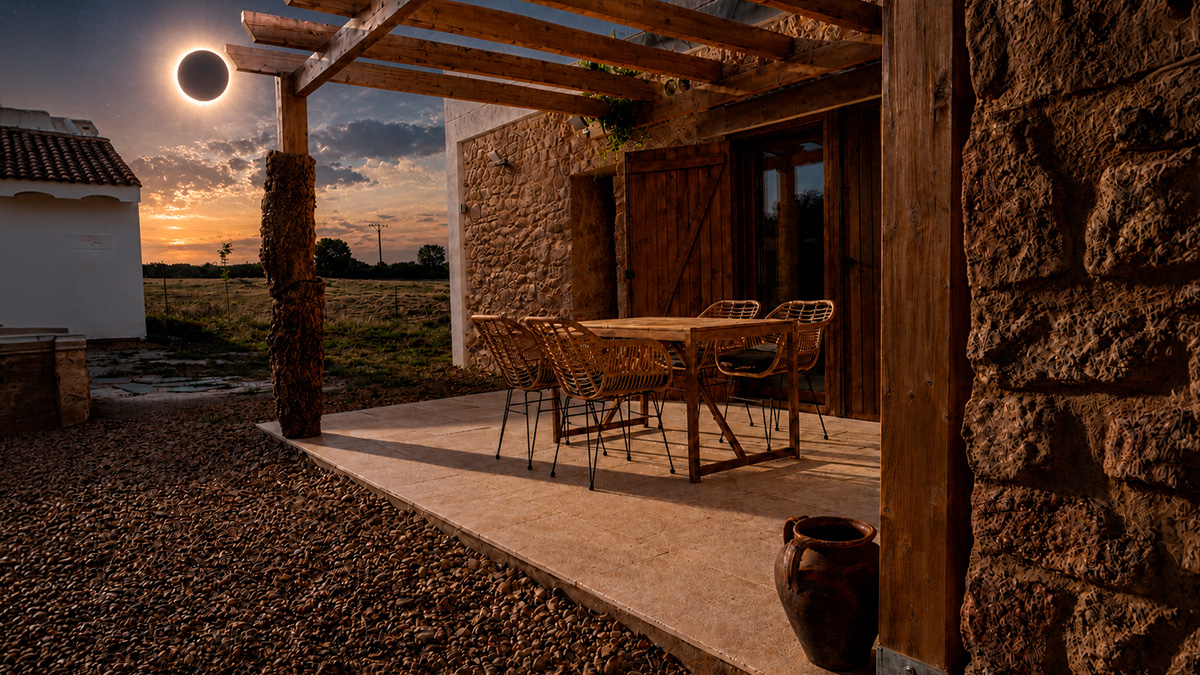
As it happens with the Sun so close to the horizon, the key to enjoying it is finding a spot with clear views to the west, free of hills, buildings or trees that could block the final minutes of the phenomenon. Our terrace and porch, facing the open dehesa, are a great spot to follow it uninterrupted.
Safety: certified glasses, no exceptions
Looking directly at the Sun, even during a partial eclipse as deep as this one, can cause serious and irreversible eye damage. Certified solar viewing glasses meeting the ISO 12312-2 standard must be worn at all times. Ordinary sunglasses, however dark, do not protect your eyes and must not be used for this purpose. Certified glasses can be found at optical shops and astronomy suppliers; it is worth reserving a pair in advance, as they tend to sell out close to the date.
That same night: the Perseids at their peak
Once the eclipse ends and night falls, the sky has a second act ready. The night of 12 to 13 August is, year after year, the date for the Perseids, the most popular meteor shower of the calendar. In 2026 the peak activity falls between 4 am and 6 am, although activity is already noticeable from 11 pm on the 12th itself.
What makes this year special is the coincidence with the new moon, which falls that same afternoon: with no moonlight competing, the sky will be darker than usual and shooting stars, including the fainter ones, will stand out far more clearly. The Perseids need no telescope or binoculars: just lie back, let your eyes adjust to the darkness for fifteen or twenty minutes, and be patient.
Part of a historic trio
This eclipse is not an isolated event. Along with the one on 12 August 2026, Spain will experience two more solar eclipses in consecutive years: a total eclipse on 2 August 2027, this time crossing the south of the peninsula (Andalusia, Extremadura and Castilla-La Mancha, much closer to home), and an annular eclipse on 26 January 2028. Three solar eclipses in three consecutive years is an exceptional run that will not happen again until well into this century. After 2028, Spain will not see another solar eclipse until 2053.
One day, two spectacles
The stars rarely align quite like this, quite literally. Starting the evening with the Sun shrinking to a thin crescent over the dehesa, and ending the night counting shooting stars under a moonless sky, makes 12 August 2026 a date worth booking well in advance. The Sierra de San Pedro, far from the light pollution of big cities, offers exactly the conditions this double phenomenon needs.
Frequently asked questions
Is it dangerous to look at the eclipse without certified glasses?
Yes, very dangerous. Looking directly at the Sun, even during a deep partial eclipse like this one, can cause serious and irreversible eye damage within seconds. Solar viewing glasses certified to ISO 12312-2 are essential; ordinary sunglasses, however dark, offer no real protection.
Do I need a telescope or binoculars to see the Perseids?
No. The Perseids are perfectly visible to the naked eye; in fact, a telescope narrows the field of view and makes it harder to follow the meteor trails. Just lie down somewhere dark, let your eyes adjust for about fifteen minutes, and be patient.
What is the best spot to see both events near Cáceres?
Anywhere with a clear horizon to the west (for the eclipse) and away from light pollution (for the Perseids). The Sierra de San Pedro meets both conditions easily, with the added bonus of open dehesa that lets you see the sky unobstructed in any direction.
Where to experience it from the Sierra de San Pedro
Our rural house in Valencia de Alcántara has its porch and grounds facing the open dehesa, with no obstacles towards the western horizon: the perfect spot for the eclipse at sunset, and for lying back afterwards under a dark sky to wait for the Perseids. Whole-house rental for 8 guests, an infinity pool for the daytime heat, and a whole night ahead to look up.
Coming to see the eclipse and the Perseids?
Check availability for 12 August.